If you trace the family tree of most beauty device companies, you will usually find a marketing department at the root. Someone had a brilliant idea for a brand, designed some sleek packaging, and then went looking for a factory to build the hardware.
This particular story starts a little differently. It starts in the year 2000, with a team of biomedical engineers who were entirely too obsessed with tissue impedance to worry about branding.
They founded a company called Viora, and for the first fifteen years of their existence, they happily ignored the consumer market entirely. While the rest of the beauty industry was discovering the power of social media marketing, Viora's engineers were busy building massive, heavy-duty aesthetic systems for surgeons and dermatologists across 65 countries. These were the kind of machines that sit on rolling carts in clinical treatment rooms and cost more than a very nice used car.
40 patents for things you cannot even see
Building hardware for physicians is a highly specific, slightly terrifying kind of engineering challenge. When a dermatologist uses a radiofrequency machine on a patient, the device has to deliver precisely calibrated energy. The consequences of getting the math wrong in a clinical setting are measured in severe complications, not just a frustrated customer leaving a two-star review online.
Because of this, Viora's team spent over a decade perfecting technology that the patient lying on the table would never even notice. While the patient just feels a pleasant warmth and hears the machine hum, the device is secretly working incredibly hard. It is running an invisible impedance monitoring system (reading the skin's electrical resistance hundreds of times per second to prevent overheating). It is using an algorithm to adjust energy output in real time.
The engineers filed over 40 patents for these invisible safeguards. Their portfolio spans multi-frequency RF energy delivery (so the energy hits the right tissue depth) and dynamic impedance adaptation (a technology they clinically validated to safely treat skin laxity). They were, in short, massive nerds solving very real clinical problems.
The beautiful, chaotic consumer boom
Fast forward to the 2010s, and the at-home beauty device market absolutely exploded. The barriers to entry were surprisingly low. A brand could source a generic, ready-made device from an overseas manufacturer, give it a beautiful pastel colorway, commission a stunning photoshoot, and launch a massively successful product line.
It was a brilliant time for marketing, but a slightly less brilliant time for results. The market quickly flooded with gorgeous devices that lacked the power to do much of anything. The "device graveyard" (that specific bottom drawer in your bathroom where disappointing gadgets go to collect dust) became a universal cultural experience.
It was an interesting tension: the brands that were incredible at consumer marketing had very little experience engineering medical-grade hardware. And the companies that knew how to build highly effective clinical devices usually had absolutely no idea how to sell something directly to a consumer.
Translating the clinic for your bathroom counter

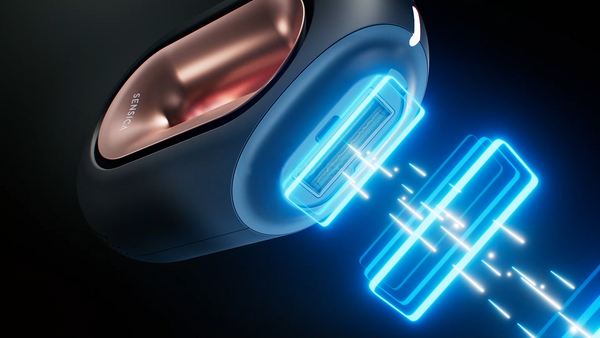
When Viora finally decided to enter the consumer market under the brand name Sensica, they took the exact opposite of the standard approach. Instead of starting with a clever marketing concept, they looked at their massive clinical machines and asked a very difficult question: how do we translate this for unsupervised home use without losing the core science that makes it work?
The easiest path would have been the one many companies took: just take a clinic device, crank the power all the way down so nobody can get hurt, and ship it in a smaller box. But reducing power without redesigning the entire energy delivery system is a bit like turning down the volume on a badly tuned radio. The sound might be quieter, but you still cannot hear the song.
Instead, the engineers had to completely redesign the core elements from the ground up to account for human nature. In a clinic, a trained professional is guiding the handpiece. At home? The user might be distracted watching television. So, Sensica had to build in dedicated contact sensors and automatic, real-time temperature management. A clinician manages your treatment schedule; at home, you need an app that tracks, guides, and reminds you to actually use the device.
The safety systems alone had to be engineered to instinctively replicate the rapid judgment calls that a dermatologist makes during a session.
Why the family tree matters
When you are shopping for a beauty device today, it is genuinely tricky to distinguish between a deeply engineered product and a purely marketed one. The packaging is equally sleek. The claims are equally bold. The price tags are often nearly identical.
But there is one clarifying question that cuts right through the noise: where did this technology actually grow up?
A company that started by building clinical systems and then translated that technology for home use has solved fundamentally harder problems than a brand that started by designing a consumer gadget. A clinical background means the core technology survived an environment where performance is measured objectively, complications are tracked rigorously, and the engineering must withstand professional medical scrutiny.
It is a bit like the difference between eating at a restaurant where the chef spent twenty years sweating in a demanding, Michelin-starred kitchen, versus eating at one where the owner simply has fantastic taste in interior design. Both restaurants might look equally inviting from the sidewalk, and both might even serve a great cocktail. But when the main course arrives, the meal itself will be an entirely different experience.