You apply your favorite high-end serum faithfully, and your skin looks brighter and more hydrated. But when it comes to real structural changes (the firmness, the bounce, the resistance to gravity), your serum is only doing half the job.
In the world of collagen banking, asking whether to invest in topicals or clinical devices is a false choice. You need both. You don't build collagen without both ingredients and energy. Here is exactly how the two halves of a real longevity routine work together.
What exactly is collagen banking?
Think of collagen banking like a retirement fund for your face and body, except a lot more fun to invest in.
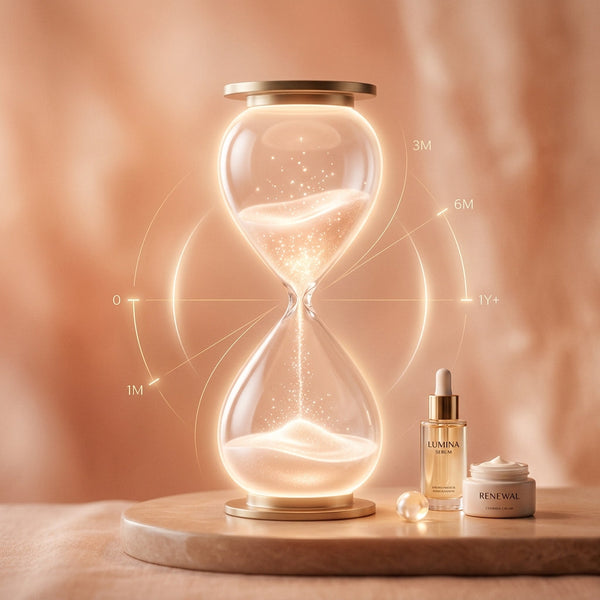
Starting in our mid-20s, our natural collagen production drops by about 1% every year. By the time we hit our 40s, we're officially in a "collagen deficit." Collagen banking is the strategy of stimulating your body to produce excess collagen while you're still naturally good at making it (usually in your late 20s and 30s).
Instead of waiting for deep wrinkles or severe laxity to show up and then trying to reverse them, you use treatments like Radiofrequency (RF) to actively "deposit" new collagen into your skin's savings account right now. You're building up a massive structural reserve so that when the aging process tries to make a withdrawal later, your skin has plenty of elasticity to spare.
The role of your skincare: the building blocks

Your creams and serums act as the defenders of the surface, which is exactly where topicals do their best work. They provide critical hydration, support the skin barrier, and deliver antioxidants that protect the collagen you already have from environmental damage (like UV rays and pollution).
A rich, high-quality cream is essential for creating the ideal environment for your skin to thrive. But biology operates on strict rules. The molecules in most topicals are simply too large to pass through the tightly packed lipid barrier of the outer skin. Because they cannot physically penetrate down to the lower dermis, they cannot wake up the cells responsible for structural repair. If your goal is to bank collagen for the future, you can't reach the target with a surface cream alone.
The role of radiofrequency: the cellular energy
To reach those deeper layers, the approach needs to shift from chemistry to physics. Radiofrequency (RF) bypasses the surface limitations entirely. It sends targeted thermal energy directly into the deeper dermal layers where the fibroblasts are resting.
This deep, controlled heat triggers a biological response called neocollagenesis. The heat tricks your body into thinking it needs to repair the tissue, which kicks those fibroblasts into high gear, forcing them to synthesize fresh, resilient collagen and elastin. Your serums provide the surface nourishment, but RF provides the physical energy required to change the actual structure of your skin.
The synergy effect
When you pair them together, you stop leaving results on the table. Think of it like a workout and a protein shake. The workout (the RF device) creates the stimulus for muscle growth. The shake (your cream) provides the nourishment to recover and build. Doing one without the other works to an extent, but the combination is where the magic happens.
Prepping your skin with a high-quality cream ensures it has the hydration and barrier support it needs to recover efficiently after a treatment session. The RF treatment, in turn, boosts local circulation, making your skin far more receptive to the nourishment you apply afterward.
Find Your Personal Protocol
Ready to start building your own collagen banking routine? Take our 2-minute assessment to find out exactly which device and timeline fits your specific goals, age, and current routine.
Take the QuizStacking your routine
Stacking these two halves safely is less about an elaborate routine and more about basic timing.
When you pick up your RF device, always start with clean, dry skin. You need to be cautious when using the device over active ingredients (like retinol or strong acids), as the heat can cause unnecessary irritation. Once your session is finished, your skin is primed and ready. This is the perfect time to follow up with a deeply nourishing cream to calm the surface, lock in moisture, and supply the building blocks your skin needs as it begins the remodeling process.
Once you start combining them, biology takes over. And speaking of biology, you might be wondering how long that process actually takes. If you want to know exactly what happens to your skin (and when) once you start banking collagen with energy, we've broken downthe exact 8-week timeline for you right here.