If you have ever scrolled through Instagram and seen a pastel-colored hair removal device that looks like a piece of modern art, you have witnessed the "transparency gap."
The at-home beauty industry is currently a $50 billion gold rush, but for the average shopper, it can feel more like a minefield. From sleek designs to glowing endorsements, it is easy to assume that a high price tag guarantees a professional-grade result. But that isn't always the case, and you need to know how to tell if you are paying for real science or just a designer box.
In the beauty world, we are used to judging products by their packaging and the influencers who love them. But when it comes to technology, beauty is often only skin-deep. While the science behind light-based hair removal is sound, the industry has developed a habit of focusing more on how a device looks on your vanity than how it performs on your skin.
The Instagram mirage
We are living in an era of influencer-driven design. Brands know that a sleek, matte-finish device with a "soft touch" grip will sell thousands of units before anyone even checks the specifications.
The problem is that many of these gadgets are designed to look high-tech without actually being high-tech. They use the same language like "clinical" and "advanced" to mask a very different reality. When the marketing budget is ten times larger than the engineering budget, the result is often a product that looks like a professional tool but works like a very expensive flashlight.
The "white label" mystery

One of the biggest secrets in the beauty world is that many brands do not actually design or build their own technology.
They use a process called "white labeling." Imagine browsing a catalog, picking an existing model, choosing a custom color, and slapping your logo on it. That is how a significant portion of the market operates. They didn't write the software or engineer the power supply; they just gave it a stylish new coat.
Imagine buying a sleek sports car, only to look under the hood and find a lawnmower engine. It looks impressive in the driveway, but it won't perform on the open road. In the beauty tech world, you can easily end up paying $400 for a designer shell wrapped around $30 worth of basic electronics.
The big myth: "All IPL devices are basically the same"
If you are shopping for hair removal, you have probably heard that "a flash is just a flash." If every device uses light, how much could they really differ?
This is the biggest myth in the industry, and believing it is the quickest way to end up with a drawer full of disappointments. Real clinical research shows that the success of a treatment depends on two things that generic devices often lack: Energy Density and Skin Sensing.
The "Oomph" (Energy Density)
Think of light energy as the fuel that drives your results. To disable a hair follicle, thermal energy (measured in Joules) must reach the root with sufficient force. While your daily treatment level should always be adjusted to suit your comfort and skin tone, a high-performance device must be capable of delivering up to 5 Joules per square centimeter (5 J/cm²) at its highest setting.
Most generic devices use low-power flashes that might singe the hair on the surface but never reach the follicle with enough force to create a permanent change. It is the technical equivalent of trying to boil a kettle with a single match: you might get some steam, but you aren't making tea anytime soon.
The Smart Brain (Skin Sensing)

Professional-grade devices don't just flash blindly. They use intelligent sensors to read your skin tone in real-time. This isn't just a safety feature; it is a performance booster. By reading your skin, the device can automatically suggest the highest effective power level for your specific tone. Or it can just refuse to flash, if your skin tone is too dark.
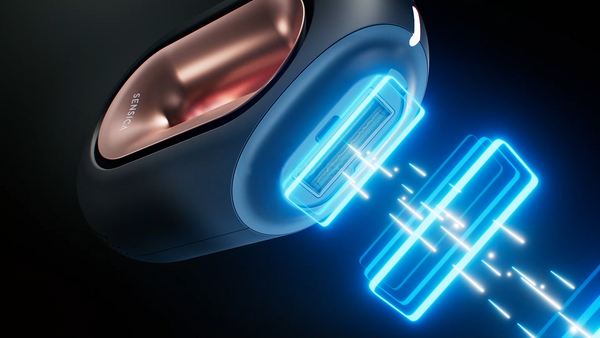
Without this, you are either using a setting that is too weak to work, or one that is too high for comfort. This is where medical pedigree makes the difference. Sensica’s engineers spent 20 years building professional systems for doctors before they ever designed a tool for home use. We used that experience to create our patented RPL™ (Reactive Pulse Light) technology, which "shrunk down" clinical standards to ensure your home device is always working at its peak power without risking your safety.
The smart shopper's checklist
The beauty tech market isn't going to become transparent overnight, but you can protect yourself by asking a few simple questions before you click "buy":
- Who actually designed this? Look for companies that have their own research and development labs and hold their own patents. If they can't name their engineering team, they probably didn't build the device.
- Does it have a real sensor? Avoid "one-size-fits-all" devices. If it doesn't intelligently read your skin tone and contact, it is likely a generic model.
- What is the device’s energy density? If the brand won't disclose the energy density, it is usually because the number isn't one they want to brag about.
- Is it a gadget or a protocol? Real hair reduction is a journey, not a magic trick. Look for brands that provide a structured 8-12 week plan and professional support to guide you through the process.
The devices that actually work are out there. They might not always be the ones with the flashiest ads, but they are the ones with the best engines.